YOUR UPLOADED REHEARSAL WORDING
Say it aloud
Transcribed from the Quizlet printouts you supplied; not confirmed as your instructor’s current script. Source wording is preserved below, with clinical clarifications separate.
LOCAL ANESTHESIA / LEARNING LAB
A growing practice space using source-linked study notes. Choose a technique to begin.
General site: buccal fold in the upper second-molar region.
*PSA usually excludes the mesiobuccal (MB) root of the first molar; MSA usually covers it. Coverage overlaps and varies. These are study regions, not precise needle-placement directions.
Understand nerve conduction & incomplete anesthesia
DENTAL ANESTHESIA / NERVE EXPLORER
Explore the original skull illustration, select a nerve and zoom in. Yellow pulses illustrate electrical signals, not blood flow.
Explore anesthetic diffusion and sodium ions, then follow the electrical signal.
Illustrative study artwork: nerve paths, label positions and tooth count have not been anatomically validated. This view does not show clinical needle placement. Review dental local anesthesia anatomy ↗
Open its explanation, memory cues and recall practice.
YOUR UPLOADED REHEARSAL WORDING
Transcribed from the Quizlet printouts you supplied; not confirmed as your instructor’s current script. Source wording is preserved below, with clinical clarifications separate.
Don’t forget to load a fresh cartridge.
Practice aspiration, then simulate deposit. Moving the syringe resets aspiration.
Blue · sodium ions Purple · anesthetic Gold · electrical signal
Conceptual close-up, not the selected nerve’s location. Timing is shortened. Anesthetic blocks sodium channels; ions keep moving outside.
Illustrative overview
SCREEN TARGET & SEQUENCE
Move the tip into the black circle, rehearse aspiration, then simulate a deposit.
Checks only the illustrated screen target and aspiration checkpoint. It does not assess clinical placement, tissue, angle or depth.
3× view follows the needle tip. Simulate deposit animates entry beneath the gum surface.
Front-of-syringe view: the needle and front barrel enter the mouth view while the handle extends off-screen. Drag the visible barrel, or tap the mouth to place the tip. Use arrow keys for small moves. The marker is a practice cue, not a validated clinical insertion point.
ANESTHETIC CARTRIDGE
Epinephrine 1:100,000

 LIDOCAINE HCl 2%
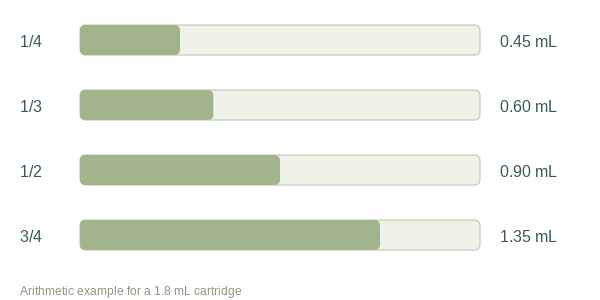
The selected fraction is a simulation choice, not a recommended injection volume. Use Practice aspiration, then Simulate deposit to move the stopper.
Start by reviewing the landmarks in your procedure guide.
Visual study simulation only. It does not evaluate 3D angle, depth, bone contact, vascular anatomy, dose suitability, or readiness to inject a patient. Clinical practice requires your instructor’s supervision.
EXPLORE THE COVERAGE
Your selected colored mouth illustration, with technique coverage notes.
This fixed overview uses opposite sides to compare different blocks. Select a technique to read its coverage notes; the illustration stays unchanged. Colored regions are a study overview, not injection targets.
YOUR ORGANIZED STUDY NOTES
The rewritten summaries link to clinical references. Technique-specific depth, needle selection and delivered volume follow supervised clinical protocols.
The original mouth, syringe and cartridge artwork are retained. The replacement coverage graphics are original concept diagrams. The simulation does not verify clinical placement.
SAY IT • RECALL IT • CHECK IT
Build confidence explaining a technique aloud, one part at a time.
Original study scripts inspired by the topics you shared. These are not an official school script or a clinically validated competency assessment. Confirm your instructor’s wording and patient-specific protocol.
Check a point after explaining it aloud. This records your self-check only; it does not grade clinical competence.
Read the clinical reference ↗Add course details after confirming them with your instructor. They appear in your rehearsal card and stay on this device/browser only. Do not enter patient information.
Clinical source check: October 18, 2026. Faculty review remains outstanding.
Practice questions from all eight study lessons
RETRIEVAL PRACTICE
CLASSROOM ARITHMETIC
Use the actual cartridge label for volume. Do not multiply epinephrine by the anesthetic percentage. Keep full precision until the final answer.
Volume = cartridge size × fraction
Enter a maximum dose supplied by your instructor for an arithmetic exercise.
This division considers only the entered anesthetic limit. It is not a clinical maximum: weight-based limits, absolute limits, epinephrine, health history, and other agents also matter. Never round a maximum upward.
Use mg/lb only with pounds. A mg/kg allowance needs kilograms. This exercise does not select a drug’s dose limit.
Compare anesthetic drugs & pharmacology
SOURCE-CHECKED STUDY REFERENCE · OCTOBER 11, 2026
Use the actual cartridge volume. A percentage converts to mg/mL by multiplying by 10.
| Solution | mg/mL | mg / 1.7 mL | mg / 1.8 mL |
|---|---|---|---|
| 0.5% | 5 | 8.5 | 9 |
| 2% | 20 | 34 | 36 |
| 3% | 30 | 51 | 54 |
| 4% | 40 | 68 | 72 |
Healthy-adult label examples, not automatic patient doses. Medical status, age, total exposure, vasoconstrictor and product-specific restrictions can reduce the permitted amount.
Pediatric dental guidance may use lower limits. The AAPD lidocaine table uses 4.4 mg/kg; a manufacturer maximum is not a treatment target.
Teaching approximation: 2.2 lb ≈ 1 kg.
The ADA describes 0.04 mg epinephrine as a common adult recommendation when the medical history calls for caution. It is not a universal dose for every cardiac diagnosis.
Exercise arithmetic only. Check anesthetic and vasoconstrictor limits separately; do not round a maximum upward.
Study nitrous equipment, patient selection & recovery
ORIGINAL STUDY NOTES
Nitrous oxide/oxygen can reduce anxiety and provide analgesia. It does not replace local anesthesia when profound pulpal anesthesia is needed.
This is a study outline, not a fixed-duration gas protocol. Flow, concentration and monitoring requirements follow professional guidance and supervised training.
AAPD: nitrous oxide/oxygen guidance ↗