Pathway practice
Reveal full route
Learning routes show common relationships, not every communicating branch.
Explore the head and neck, one layer at a time.
Reference figures retain their published anatomy and labels. This study edition has not received faculty review.
Choose a system, explore a structure, then test your recall.
Independent study summaries with textbook and university references. Typical pathways are simplified; individual anatomy varies.
| Number | Name | Type | Core function | Opening / route |
|---|
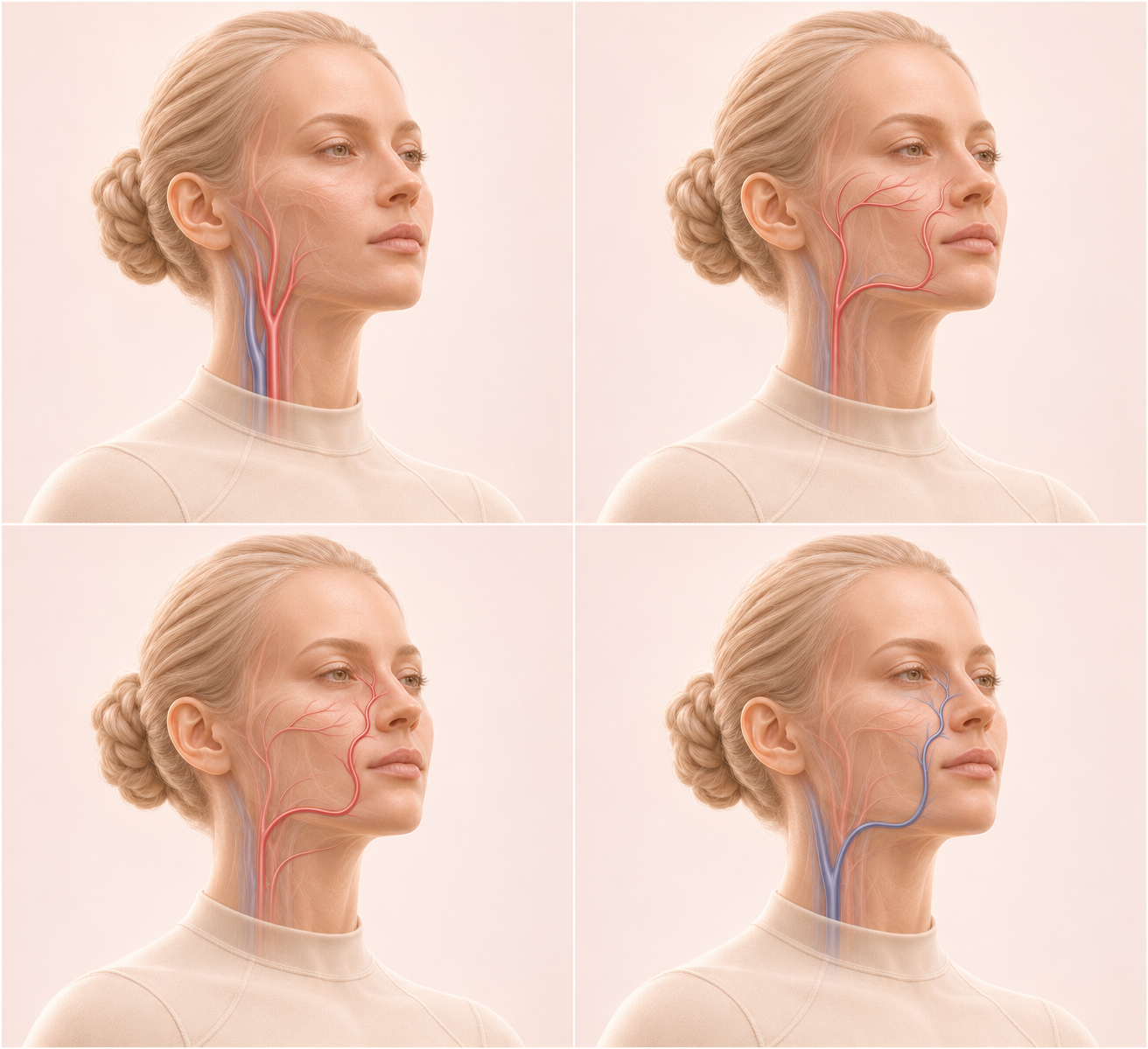
Superior thyroid · ascending pharyngeal · lingual · facial · occipital · posterior auricular · maxillary · superficial temporal.
Maxillary and superficial temporal are terminal branches. Branch order and common trunks vary.
University anatomy table ↗Learning routes show common relationships, not every communicating branch.
| Pathway | What to remember |
|---|---|
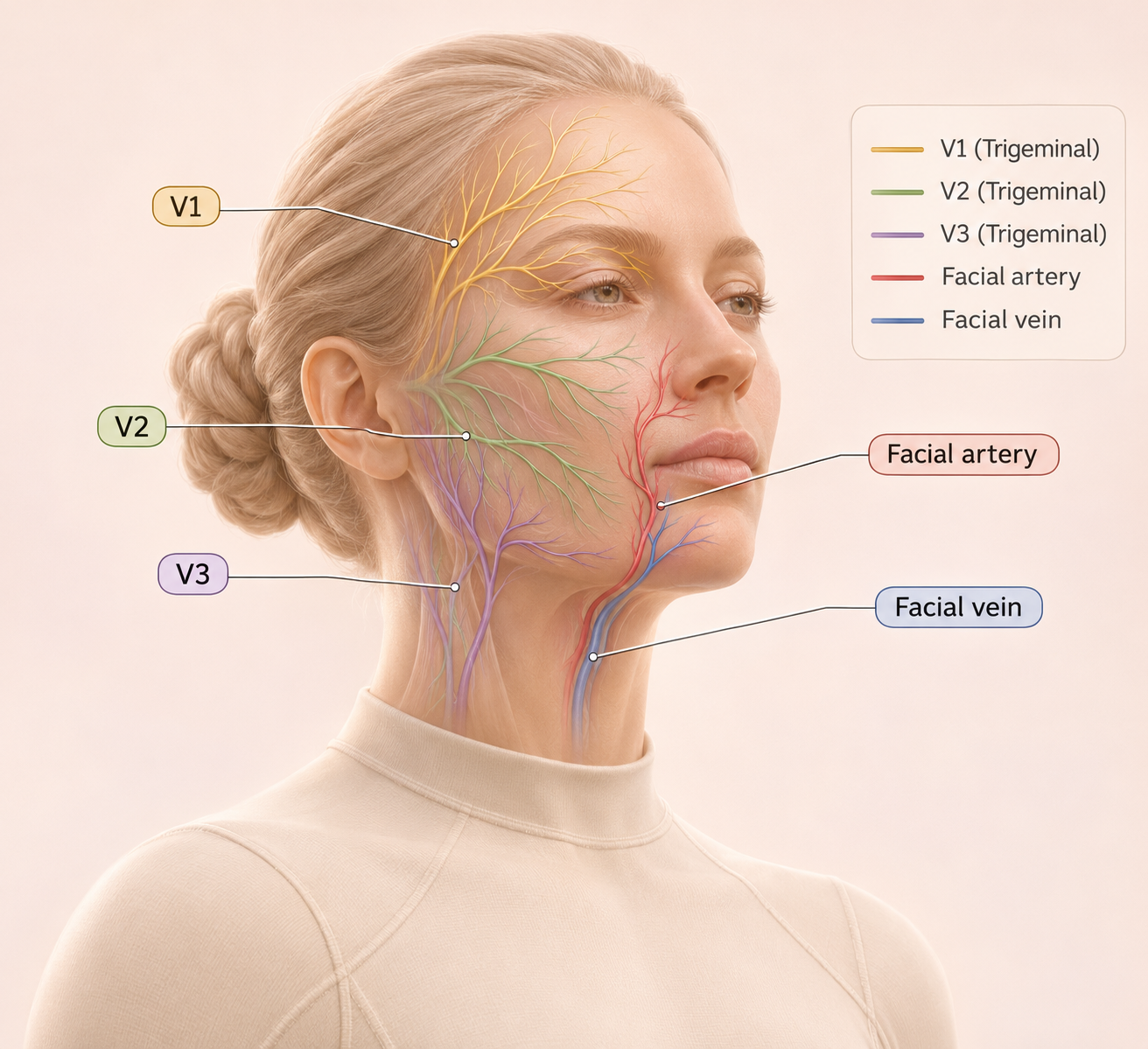
| V1 · ophthalmic | Sensory only; forehead, upper eyelid, cornea and dorsum of nose. Passes through the superior orbital fissure. |
| V2 · maxillary | Sensory only; midface, upper teeth, palate and nasal region. Passes through foramen rotundum. |
| V3 · mandibular | Mixed; lower face, lower teeth and general sensation to anterior tongue; motor to muscles of mastication. Passes through foramen ovale. |
| Upper teeth | Anterior superior alveolar: incisors/canine. Middle superior alveolar: commonly premolars and sometimes mesiobuccal root of first molar; it may be absent. Posterior superior alveolar: most molars, with common overlap at the first molar. |
| Lower teeth & chin | Inferior alveolar travels in the mandibular canal. Its incisive continuation supplies anterior mandibular teeth; mental nerve exits the mental foramen to the lower lip and chin. The mylohyoid branch leaves before the mandibular foramen and is motor to mylohyoid and anterior digastric. |
| Other V2/V3 branches | V2: infraorbital branches reach lower eyelid, side of nose and upper lip; greater/lesser palatine and nasopalatine nerves supply palatal regions. V3: lingual nerve supplies anterior tongue general sensation; long buccal nerve supplies cheek mucosa and buccal gingiva of mandibular molars. Long buccal is sensory; buccinator motor supply comes from VII. |
| Tongue | Anterior 2/3 general sensation: lingual nerve (V3). Anterior 2/3 taste: chorda tympani (VII), carried with lingual nerve. Posterior 1/3 sensation and taste: glossopharyngeal (IX). Motor: hypoglossal (XII), except palatoglossus (X). |
Facial nerve (VII) passes through the parotid gland, but its branches there supply facial expression muscles; they do not provide the parotid’s secretomotor pathway.
This vocabulary is for anatomy review and does not replace clinical evaluation or current treatment guidance.
Independent summaries and original relationship charts. Faculty review remains outstanding.